

SinterCast är ett industribolag. Bolaget är specialiserat inom processtyrningssystem för volymproduktion inom gjutgodsindustrin, särskilt inriktat mot kompaktgrafitjärn (CGI). Idag tillhandahålls precisionsmätningar, samt komponenter och tillhörande installationstjänster. Störst marknad återfinns inom den nordamerikanska marknaden, där kunderna är verksamma inom fordonsindustrin. SinterCast grundades 1983 och har sitt huvudkontor i Katrineholm.
Pressmeddelanden
2026-04-08
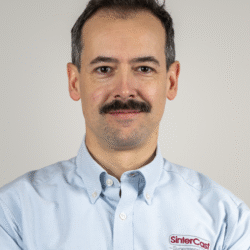
Deputy CEO Dr. Vítor Anjos
”CGI is expected to grow five times faster than electrification in commercial vehicles, a dynamic not always fully appreciated by the market. The long-term case for SinterCast is stronger than ever.”
For those unfamiliar with SinterCast, could you describe the business, what the Company does, and which end markets it addresses?
SinterCast is a technology company that enables reliable production of Compacted Graphite Iron (CGI), a type of cast iron that is stronger and stiffer than conventional cast iron. We achieve this through a proprietary process control technology and system that SinterCast develops, licenses, and installs at foundries worldwide.
The primary application for CGI is internal combustion engines. Since the material is stronger, it allows for higher combustion pressures inside the engine, resulting in improved fuel efficiency of up to 10 % compared to traditional engines. At the same time, the structural strength of CGI means the engine itself can be made smaller and lighter. These benefits are most pronounced in larger engines, where fuel consumption is high and any efficiency gain translates directly into lower CO2 emissions and reduced operating costs.
Our business model is built on a production fee charged per unit of CGI produced by foundry customers. This creates a high proportion of recurring revenue that scales directly with production volume.
The end markets addressed today are primarily heavy-duty commercial vehicles, representing approximately 50% of production, pick-up trucks at approximately 45%, and industrial applications such as marine, railway, and off-road at approximately 5%.
SinterCast’s CGI technology is used in passenger vehicles, commercial vehicles, and industrial power applications. How do you view the revenue mix across these segments today, and how do you expect it to evolve over time?
Sintercast’s current production mix is approximately 50% heavy-duty commercial vehicles, namely the large trucks used for long-haul transport, and approximately 45% pick-up trucks, predominantly the super-duty, full-size, and mid-size pick-ups sold in the North American market. The remaining 5% covers what we refer to as industrial applications, including marine, railway, and off-road.
Looking ahead, we expect the pick-up truck segment in North America to remain broadly stable. It is a mature market, and we do not anticipate significant volume changes in the near term. In industrial applications, we see meaningful growth, particularly driven by gensets used in server and data centre infrastructure, where demand for AI computing is creating substantial new energy requirements. That said, absolute volumes in industrial applications remain much smaller than those in automotive.
The most significant shift we foresee is in commercial vehicles. We expect that segment to grow from its current 50% share of our production volume to approximately 75% by 2030. This is the primary growth driver for CGI going forward, supported by strong new programme wins and the ongoing commitment from OEMs to develop more efficient internal combustion engines.
Year 2025 was a challenging year for CGI series production, with volumes declining, largely driven by a sharp contraction in North American commercial vehicle production. How do you view the prospects for a recovery in year 2026, and what underpins confidence in the long-term demand trajectory for CGI?
The past two years have been challenging, particularly for commercial vehicles and especially in the North American market in 2025. However, this extended period of reduced purchasing has created pent-up demand for fleet renewal: operators have not been replacing vehicles at the normal rate, and that situation is not sustainable indefinitely. We therefore expect a recovery in the second half of 2026, supported by greater clarity on tariffs and trade policy in North America, which is helping fleet buyers regain confidence and commit to investments.
On the long-term demand side, the structural argument for CGI remains highly compelling. Stringent emissions regulations and the ongoing need for more fuel-efficient internal combustion engines are the fundamental drivers. What we have seen over the past few years is that electrification is proving far more difficult than many anticipated, and if it is challenging for passenger vehicles, it is substantially more so for heavy-duty commercial vehicles, where constraints related to charging infrastructure, vehicle range, and operational flexibility are much more pronounced.
As a result, OEMs that had previously reduced investment in internal combustion engine development are now returning to this area and planning new engine launches. This provides strong visibility and confidence in future growth. To put this in perspective, today approximately 40% of new commercial vehicles are equipped with CGI engines. We expect that figure to reach 80% by 2030. Over the same period, electrification is forecast to increase from 2% to approximately 10%. CGI is therefore expected to grow five times faster than electrification, a dynamic that is not always fully appreciated by the market.
Despite the short-term volume headwinds, 2025 was a prolific year for new programme development. SinterCast secured high-volume CGI programmes with two new commercial vehicle OEMs starting production in 2026 and 2027, new off-road programmes with a major global agricultural OEM starting production in 2028, and the first CGI production in India is set to begin in Q2 2026. How do you see this programme pipeline as the foundation for the earnings recovery ahead?
If there is one genuinely positive takeaway from 2025, it is the reinforcement of the long-term growth outlook. It may have been one of the strongest years in terms of new programme wins. There are two commercial vehicle programmes starting in 2026 and 2027, two new off-road programmes starting in 2028, and two additional high-volume commercial vehicle programmes currently under development, targeting production start approximately 2031 – this represents a very strong pipeline.
The earnings impact of this pipeline is direct and meaningful. The production fee model means that every incremental unit of CGI produced translates into revenue immediately. Since the business model is highly scalable, with the ability to accommodate significant volume growth without materially increasing the cost base, the revenue growth from these new programmes is expected to flow through to improved margins and stronger earnings. The combination of recovering near-term volumes and a well-defined long-term programme pipeline provides confidence in the forward trajectory.
SinterCast has raised the long-term production target to eight million engine equivalents by year 2031, roughly double the current volumes. What are the key building blocks required to reach that milestone, and how important is the Asian expansion, particularly the ramp-up in China and India, to achieving it?
The confidence to raise the target to eight million engine equivalents by 2031 stems directly from new programme wins in 2025. OEMs are committed, foundries are progressing with the work, and the programmes are advancing. The most important factor now is regulatory and political stability. Uncertainty related to emissions legislation and trade policy can affect the timing of OEM investment decisions, and that is the variable monitored most closely.
Asia is an important part of the growth story. China and India are both expected to make meaningful contributions to production volumes over the coming years, and the ramp-up in those markets is a key component of reaching the 2031 milestone. Beyond organic growth in CGI, a process has also been initiated to explore inorganic growth opportunities, namely areas where SinterCast may leverage expertise in precision measurement and process control, brand strength, and international commercial reach to deliver additional value beyond the core business.
Where do you see SinterCast in two years, and what is the strategy to establish the Company as the undisputed global standard for CGI process control?
In two years, SinterCast is expected to be in a clearly stronger position, with several of the newly secured programmes having entered series production, recurring revenue increasing, and margins expanding as the operational leverage in the business model takes effect. The recovery in commercial vehicle markets, combined with the new programme ramp-ups, is expected to create a meaningfully different financial profile compared with the current position.
Strategically, the objective is to continue doing what has made SinterCast successful: staying close to OEMs and foundries, maintaining technical leadership in CGI process control, and being the partner of choice whenever a manufacturer decides to adopt CGI.
At the same time, the ambition is to extend that platform beyond the core business, leveraging expertise in precision measurement and process control into adjacent opportunities that may further strengthen and diversify the company’s long-term growth.
Can you give three reasons as to why SinterCast is an attractive investment today?
The first reason is the structural growth in CGI adoption. We expect CGI penetration in new commercial vehicles to double from approximately 40 % today to 80 % by 2030. That growth is underpinned by tightening emissions regulations, the practical limitations of electrification in heavy-duty applications, and a renewed commitment from OEMs to develop more efficient internal combustion engines. The long-term demand environment is as strong as ever.
The second reason is the programme pipeline. The new programme wins in 2025 provide exceptional visibility into future volume growth, with programmes starting in 2026, 2027, 2028, and extending to 2031. All of these represent incremental volumes with new OEM customers, and each one translates directly into recurring production fee revenue.
The third reason is the business model itself. With a gross margin consistently above 70%, recurring revenue accounting for more than 90% of sales, and a highly scalable cost structure, SinterCast has exceptional operational leverage. As volumes recover and new programmes ramp up, a significant proportion of incremental revenue flows directly to the bottom line, creating a compelling combination of growth visibility and margin expansion potential.
Aktiekurs
97
Värderingsintervall
Bear
N/ABase
N/ABull
N/AUtveckling
Huvudägare
2026-02-25